
There is a moment in business ownership when your plate starts looking like Thanksgiving.
Customer complaints. Training. Scheduling. The decision someone needs by the end of the day.
Just when you think you can finally sit down, another question lands on the table.
And somehow, everyone still looks at you.
I’ve seen capable owners fall into this pattern because being needed feels productive. You solve the problem, make the decision and keep the business moving. For a while, it works.
Then the business grows.
The plate gets heavier.
At some point, leadership stops being about how much you can carry. You have already proven you can carry it.
Answer this honestly. What are you willing to put in someone else’s hands?
1. Go, build a team, not an audience.
Your employees can become one of your greatest assets.
They can also become your greatest challenge when the business trains them to wait for you.
When every decision comes back to the owner, people develop a predictable habit. They stop looking for solutions and start looking for permission.
That creates a bottleneck disguised as leadership.
Delegation goes beyond handing someone a task. It means giving them the context, authority and accountability to own an outcome.
Ask yourself:
What decisions can my team make without me?
That question can tell you more about the strength of your organization than the size of your payroll.
2. Grow together. Give authority a seat at the table.
A manager may oversee operations and still have to call the owner before solving a routine problem.
That keeps the owner involved in everything. It also keeps the team from growing.
So what does a strong team need to make decisions without you?
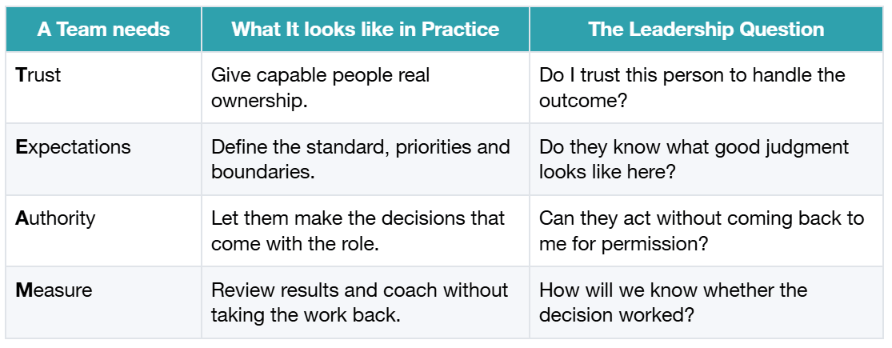
Trust without expectations creates confusion.
Expectations without authority creates frustration.
Authority without measurement creates drift.
Put all of them together, and you give people something more valuable than a task.
You give them room to lead.
3. Let culture glow in the small decisions.
Leadership shows up most clearly when things get difficult.
What happens when someone makes a mistake?
What happens when an employee challenges your idea?
What happens when doing the right thing makes the conversation uncomfortable?
Those moments reveal your culture.
People remember whether you listened. They remember whether you addressed the problem. They remember whether your standards held when it would have been easier to let something slide.
That takes courage.
Clarity helps people know where they stand. And your consistency helps them trust what they see.
4. Share. Know what to hand off.
As the business grows, more people should be solving problems, making decisions and taking ownership.
Your role changes with them.
You become less of the person carrying every plate and more of the person deciding who is ready to carry the best fit.
You stop measuring your value by how many problems reach your table.
You start measuring it by how many capable people can move the business forward without you.
Eventually, the goal is, of course, to build a team strong enough to carry what you put down.
And that may be the clearest sign that you are finally leading the business, instead of simply holding it together.
If you’re starting to think about what you should keep on your plate and what you’re ready to hand off, let’s connect. I’d be glad to be a practical sounding board as you explore what stronger, more intentional leadership could unlock for your new business.