

I once sat with someone who had a spreadsheet open on one side of the table and a picture of his family on the other.
The spreadsheet had the things you’d expect.
Investment range.
Revenue projections.
Operating costs.
The family photo showed what he was actually trying to protect.
His wife. His kids. A life with enough room to breathe.
That table captured something I think every aspiring business owner should understand:
You aren’t buying a business in isolation. You’re buying a financial structure that has to support a life.
I’ve been in franchising since 2004, and I’ve seen people get excited about a concept because the brand looks strong, the industry feels promising or the numbers at the top of the page catch their attention.
Then we get to the questions underneath.
How much capital can you comfortably put at risk?
How much working capital will you need?
What happens if the business takes longer than expected to reach its stride?
How involved do you want to be?
Those questions actually enlarge your dream because they give it a foundation.
Start With Your Financial Parameters
Before you compare franchises, I encourage people to establish a financial perimeter.
Think of it like marking the edge of a property before you build the house.
Your perimeter might include:
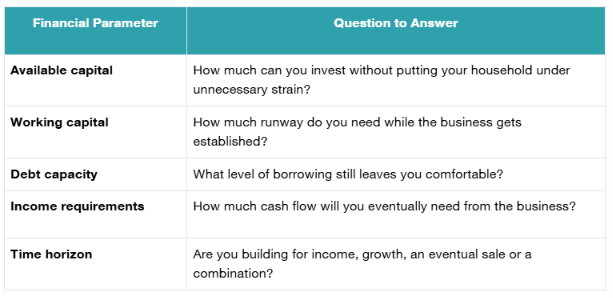
A franchise can be attractive and still fall outside your financial perimeter.
The sooner you know it, the less time you spend falling in love with a business you cannot responsibly own.
Then Decide What Autonomy Actually Means
Autonomy sounds wonderful until you define it.
I sometimes ask clients to imagine an ordinary Tuesday five years from now.
The alarm goes off.
Where are you working?
Who is running the operation?
Are you solving customer problems at 9 a.m., reviewing performance reports from home or walking into the business because you genuinely enjoy being there?
That Tuesday tells us something.
So does the spreadsheet.
Build for Cash Flow, Then Think About Enterprise Value
I use the phrase cash flow machine because a business has to work in the present before it can create possibilities for the future.
You need to understand what drives revenue and margin.
What the owner has to do personally.
And what can eventually be delegated.
Then comes the longer view.
Can this become an asset?
Enterprise value allows you to create an option that a salary cannot naturally provide.
You may grow into multiple locations.
You may build a portfolio.
You may simply create enough financial flexibility to make decisions from a stronger position.
The Picture Comes Before the Spreadsheet. The Spreadsheet Comes Before the Signature.
I think about that family photo often.
It is easy to begin with the franchise brochure.
I prefer beginning at the kitchen table.
Define life as you define the numbers.
Then ask whether the two belong together.
That is what fit means to me.
Final Thoughts
The right business should give you something worth building toward and numbers you can defend along the way.
Because five years from now, you won’t be living inside the revenue projection.
You’ll be living inside the life those numbers helped create.
If you’re ready to test the numbers against the life you want, pull up a chair. Bring the spreadsheet. Bring the family picture. I’ll help you make sense of both.