The engines are running. The destination has been chosen. You are already seated. Beyond the windshield, the runway lights stretch into the distance like a path disappearing into darkness.
Yet despite all the preparation that has happened beforehand, the pilot does not simply push the throttle forward and hope for the best.
They review fuel levels. They study weather conditions.
They look for risks that may not be visible from the ground.
Because experienced pilots understand something important: most mistakes do not happen in the air.
They happen before takeoff.
Business ownership is remarkably similar. Many professionals spend months evaluating franchise brands, comparing industries, studying investment ranges, and imagining what life could look like as an owner. Yet the most important questions often remain unanswered.
How much time will this actually require?
How do I know the numbers are real?
Am I too late in life to make a move like this?
Those are not small questions. They deserve thoughtful answers.
And before any ownership journey begins, they deserve careful evaluation.
Looking Beyond the Dashboard
When someone asks about the time needed, they are rarely pertaining to age.
They are asking about the length of the runway.
They are wondering whether there is enough time left to build something meaningful.
Whether they have enough energy left to learn something new.
Whether making a significant decision now is wise or reckless.
The interesting thing is that age itself is rarely the deciding factor.
Experience often matters far more.
After all, the person who has spent twenty-five years leading teams, managing budgets, navigating uncertainty, and solving problems under pressure is not starting from zero.
They are bringing decades of accumulated judgment with them.
A franchise system can provide training, support, and processes. What it cannot easily teach is leadership, discipline, emotional resilience, and decision-making under pressure.
Many experienced professionals already possess those skills.
In fact, they may be the very reason ownership becomes more realistic later in life rather than less.
Choosing your Seat in the Cockpit
One of the biggest misconceptions in franchising is that every owner works eighty-hour weeks forever.
Certainly, some businesses require heavy owner involvement. Others do not.
The more useful question is not, “How many hours will I work?”
It is, “What role will I play inside the business?”
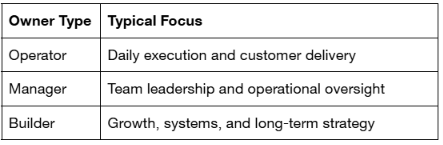
Many professionals assume ownership automatically means becoming the operator.
Some franchise models are designed around owner-operators. Others are structured around managers and systems. Some can even become semi-absentee over time, allowing the owner to focus on growth rather than day-to-day operations.
Understanding that distinction can dramatically change the conversation.
Because what many executives are actually seeking is not another demanding job.
They are seeking greater control over how their time is spent.
How Do You Know If the Numbers Are Real?
This might be the most important section in this entire article.
Every franchise presentation contains numbers.
The challenge is determining which numbers matter.
Here is a simple rule:
Never fall in love with averages.
Look for ranges.
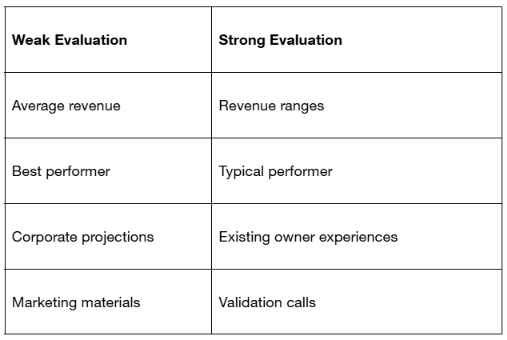
The best information rarely comes from a slide deck.
It comes from conversations with franchisees already operating inside the system.
Talk to the owners who are thriving.
Talk to the owners who struggled initially.
Talk to the owners three years into the journey rather than three months into it.
Patterns emerge surprisingly quickly.
Here’s a practical exercise I often recommend.
Forget opening day.
Forget ribbon cuttings.
Forget the excitement of becoming an owner.
Instead, picture a random Tuesday morning three years from now.
The novelty has worn off.
The business is established.
Your routine is predictable.
Now ask yourself:
What time am I waking up?
Who is opening the business?
What decisions require my attention?
Can I attend a family event without checking my phone every fifteen minutes?
Can I take a week off?
Can the business operate successfully when I am not physically present?
Eventually, every business becomes ordinary.
The real objective is ensuring that ordinary life looks the way you want it to look.
Why the Journey Matters
But ownership itself is not the goal. This may sound strange coming from someone who believes strongly in business ownership.
Control is. Flexibility is. Options are.
The right path is the one that aligns with your family, your priorities, your financial goals, and the kind of future you want to create.
That is why the best ownership decisions are rarely emotional.
They are thoughtful. Measured. Deliberate.
Much like a pilot reviewing a flight plan before departure, they are made with a clear understanding of both the opportunity and the responsibility ahead.
Final Thoughts
The professionals who make the strongest ownership decisions are usually not the ones chasing excitement.
They are the ones seeking clarity.
They understand that buying a business is not about escaping work. It is about creating more control over where their effort goes, how their time is spent, and what kind of future their work ultimately builds.
If you have been asking questions like “How much time will this take?”, “How do I know the numbers are real?”, or even “Am I too old to start something of my own?”, an introductory call with me can help you evaluate those questions in a practical, grounded way.
Because before any worthwhile journey begins, clarity should come before takeoff.